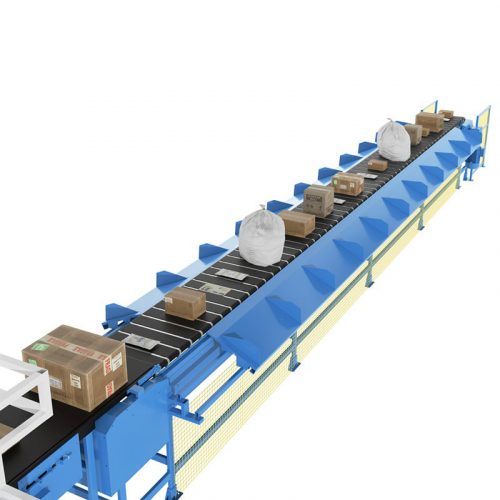
E-commerce warehouses have one characteristic that makes sorting difficult:
variety.
The warehouse may process thousands of products every day, and those products can have completely different sizes, weights and packaging.
This is one reason cross belt sorters are frequently considered for e-commerce applications.
E-Commerce Is Not Just About More Parcels
It is also about more destinations.
A parcel may need to go to a customer, a packing station, a carrier, a regional hub or another processing area.
At the same time, the warehouse may need to handle:
- Small cartons
- Polybags
- Shoes
- Apparel
- Accessories
- Consumer products
- Mixed-size packages
The sorting equipment therefore needs a certain amount of flexibility.
How Does a Cross Belt Sorter Help?
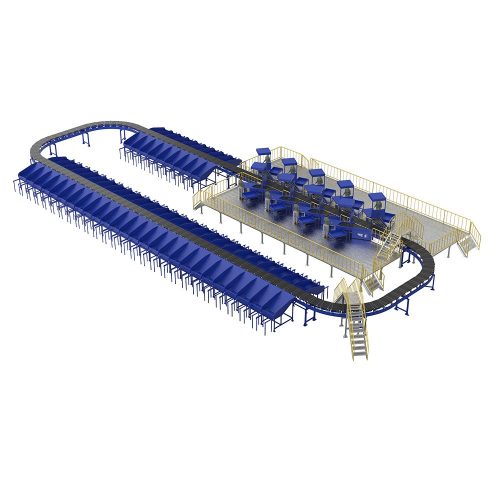
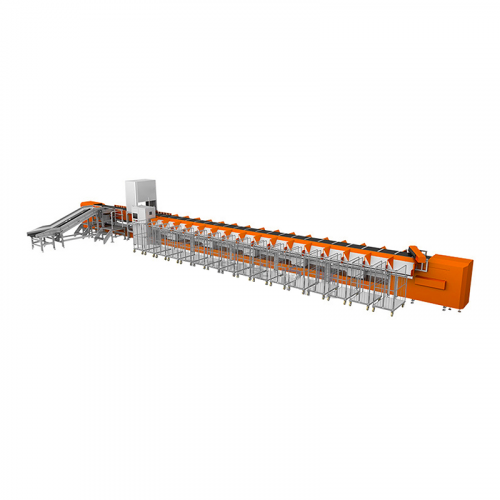
A cross belt sorter uses individual carriers.
Each carrier transports a parcel along the sorting path.
When the parcel reaches the correct destination, the carrier belt moves sideways and discharges the parcel.
This provides controlled movement without requiring the entire main conveyor to stop or change direction.

Why Is That Useful for E-Commerce?
E-commerce fulfillment often involves many small orders.
A warehouse may need to sort products toward many destinations.
The cross belt concept can support a large number of discharge points along the sorting path.
This can be useful for:
- Order consolidation
- Shipping destination sorting
- Store replenishment
- Carrier separation
- Regional distribution

What About Polybags?
Polybags are common in apparel and e-commerce.
They can be more difficult to handle than rigid cartons because they can deform, fold or move differently on a conveyor.
This does not automatically mean a cross belt sorter is suitable for every polybag.
Actual product testing is still important.
The size, weight, packaging material and carrier design all matter.
What About Small Parcels?
Small products are another reason e-commerce operators consider cross belt sorting.
Individual carrier handling allows the equipment to be designed around specific minimum parcel dimensions.
However, “small parcel” is not a universal specification.
A supplier needs the actual dimensions.
E-Commerce Peak Periods
A normal weekday may not represent the real operating requirement.
Shopping festivals, holiday periods and promotions can significantly increase order volume.
A sorting line should therefore be evaluated against peak conditions.
At the same time, oversizing the machine too far above the actual requirement can increase investment unnecessarily.
The right balance is important.

What About Integration?
The cross belt sorter is normally one part of the process.
A typical e-commerce operation may include:
Picking → Consolidation → Induction → Scanning → Sorting → Packing/Dispatch
The sorter needs to fit into this flow.
If the sorter runs faster than the packing area can process parcels, the problem simply moves downstream.
When Does a Cross Belt Sorter Make Sense?
It may be worth considering when an e-commerce operation has:
- High parcel volume
- Many destinations
- Mixed parcel sizes
- Repetitive manual sorting
- Limited tolerance for sorting errors
- A need for future capacity
But it should still be compared with other sorting technologies.
The right decision comes from the product profile and workflow.
E-commerce fulfillment is changing quickly.
The sorting technology that works today should ideally also leave the warehouse enough flexibility to handle tomorrow’s product mix.