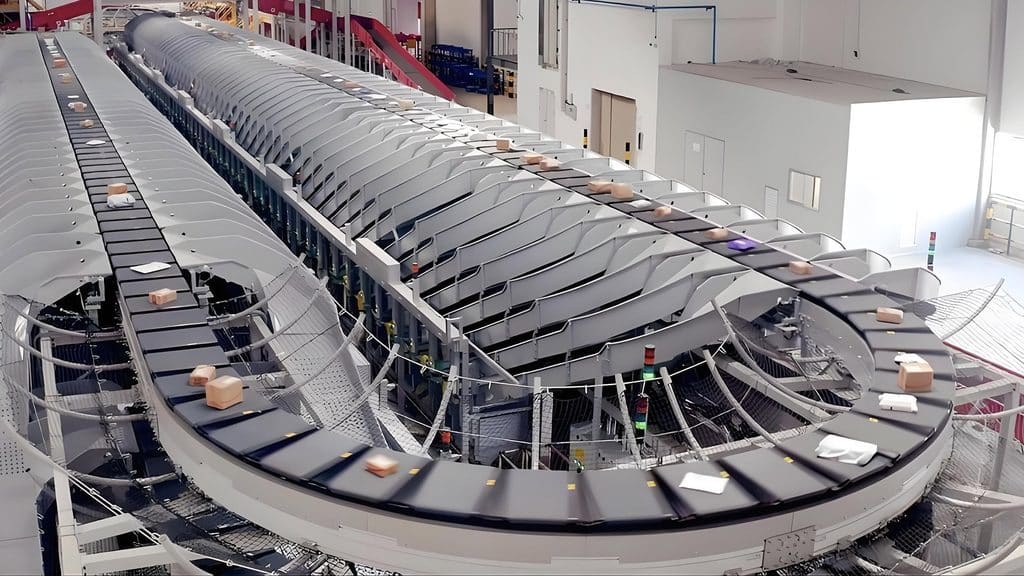
Choosing a sorter can become confusing very quickly.
One supplier recommends cross belt.
Another recommends tilt tray.
Both can handle large volumes.
Both can serve multiple destinations.
Both can be used in e-commerce and distribution operations.
So which one is actually better?
The honest answer is: it depends on the products and the workflow.
How Does a Tilt Tray Sorter Work?
A tilt tray sorter consists of a series of trays moving along a track.
A parcel is placed on a tray and transported to its assigned destination.
At the correct point, the tray tilts and the parcel slides into a chute or onto another conveyor.
The tray then returns to its normal position.
The basic principle is straightforward and has been used in automated sorting applications for many years.
How Is a Cross Belt Different?
A cross belt sorter also uses individual carriers.
The difference is how the product is discharged.
Instead of tilting the carrier, a cross belt carrier uses a small belt to move the parcel sideways.
This can provide controlled discharge and makes the technology suitable for a variety of products.
Which One Handles Small Products Better?
Both technologies can handle small products, but the actual answer depends on the carrier design.
Product dimensions, weight, shape and packaging all matter.
For example, an apparel polybag behaves differently from a rigid carton.
A shoe box behaves differently from a small irregular parcel.
It is therefore not enough to ask which sorter has the highest rated capacity.
The product profile needs to be tested.

What About Fragile Products?
Controlled product handling may be important for certain applications.
A cross belt sorter can provide a relatively controlled discharge because the parcel is transferred by the carrier belt.
Tilt tray sorters rely on the tray tilting and the product sliding off.
That does not mean tilt tray sorters are unsuitable for delicate products.
It simply means the product characteristics should be considered when selecting the technology.
What About Throughput?
Both can achieve high throughput.
But advertised throughput should always be treated carefully.
Actual performance depends on:
- Carrier spacing
- Induction rate
- Product size
- Product spacing
- Number of destinations
- Scanning performance
- Discharge configuration
A sorter running at a high mechanical speed does not necessarily mean the entire warehouse can process that many parcels.
Floor Space Can Also Matter
The warehouse layout may influence the decision.
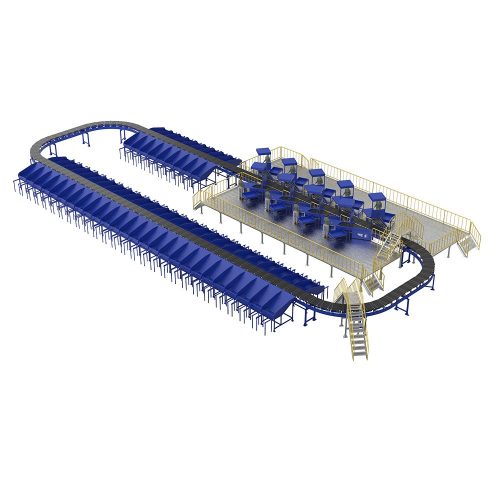
A loop sorter, linear sorter or another configuration may fit better depending on the available building footprint.
Ceiling height, column positions, loading areas and existing conveyors can all affect the final design.
This is why a good sorter project usually begins with a warehouse layout rather than a product catalogue.

So Which One Should You Choose?
A simple way to think about it is:
Choose based on the parcel and the process—not the name of the technology.
Cross belt sorters can be attractive for operations requiring flexible handling of different products and many destinations.
Tilt tray sorters can be attractive for high-volume operations with suitable product profiles and a well-defined sorting workflow.
Both technologies have their place.
Ask These Questions Before Making a Decision
Before choosing between them, look at:
- What is the smallest product?
- What is the largest?
- What is the weight range?
- How many parcels per hour are expected?
- How many destinations are required?
- What happens during peak season?
- How much floor space is available?
- How will parcels be inducted?
- What scanning technology will be used?
- Can the system be expanded later?
Once those questions are answered, the choice usually becomes much clearer.
The best sorter is rarely the one with the most impressive brochure.
It is the one that works reliably with the products you actually handle every day.